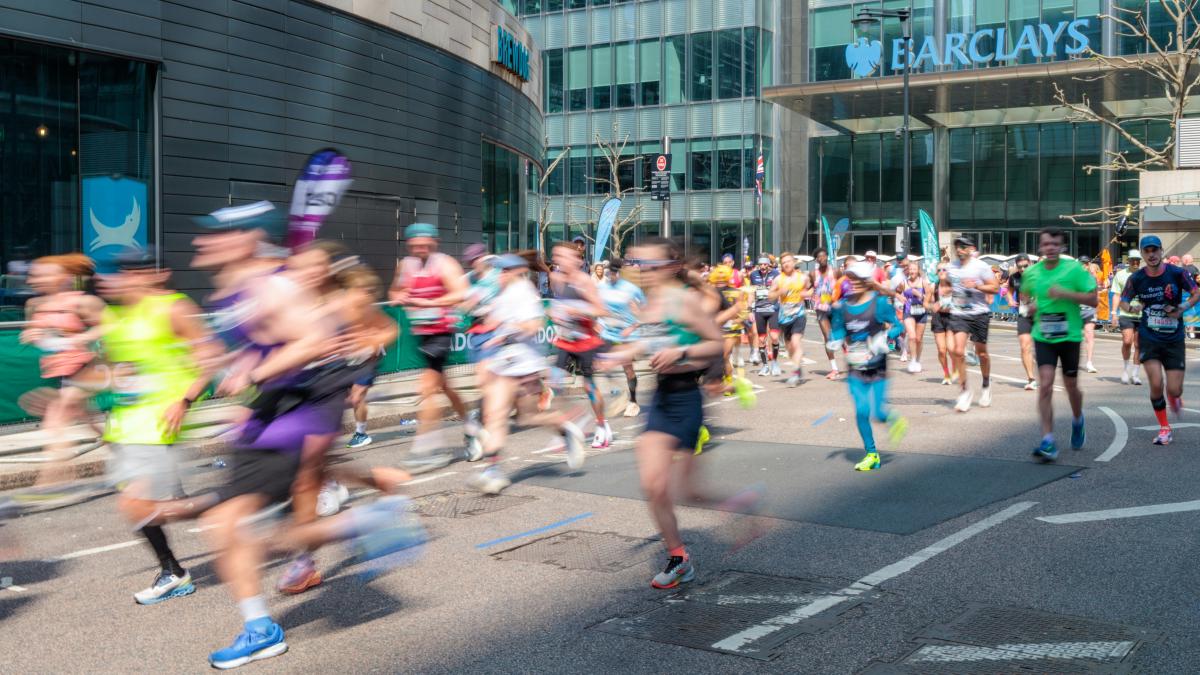
I ran my first World Marathon Major in 2018. Seven years later, I’ve completed 3/6 of the original races: Chicago, Berlin, and Tokyo. I’ve also finished Sydney, which Abbott added to the roster in 2025. That leaves three originals still to go: New York, London, and Boston.
The question I keep coming back to is a simple one: can I complete the original six before 2028? That would be ten years start to finish — which sounds like a long time until you understand how the entry system actually works.
Most content about the World Marathon Majors focuses on the aspiration: the six cities, the Six Star medal, the bucket list narrative. Very little of it is honest about the systemic barriers between wanting to complete the journey and actually doing it. This post documents what that looks like from the inside — with years of rejection emails to prove it.
Where I Started #
I got Berlin and Chicago on my first try in 2018 — Berlin on September 16th, Chicago three weeks later on October 7th. At the time I had no real sense of how running two marathons 21 days apart would affect performance. Berlin was 4:07:57, Chicago was 4:01:18. I was 25, thought I’d knock out all six before turning 30, and assumed the entry system would cooperate.
It didn’t.
Tokyo took several more attempts. I finally ran it in March 2024 — six years later, and already 31. The time was 3:33:05, nearly 35 minutes faster than Berlin 2018. Sydney followed in August 2025 with a 3:32:59, almost identical.
| Race | Date | Finish time |
|---|---|---|
| BMW Berlin Marathon | Sep 16, 2018 | 4:07:57 |
| Bank of America Chicago Marathon | Oct 7, 2018 | 4:01:18 |
| Tokyo Marathon | Mar 3, 2024 | 3:33:05 |
| TCS Sydney Marathon | Aug 31, 2025 | 3:32:59 |
The races I’ve done gave me a clear picture of how entry works when it works. What they didn’t prepare me for was how different New York, London, and Boston would be to access, each for a different reason.
World Marathon Majors Entry: The Real Obstacle #
The standard framing is that completing all six Majors is a fitness challenge. It isn’t, at least not primarily. The bottleneck is access, not preparation.
Here’s what the numbers actually look like:
| Race | Applications (recent) | Approximate spots | Acceptance rate |
|---|---|---|---|
| London | 1,100,000 (2026) | ~50,000 | ~4.5% |
| New York | 165,000 (2024) | ~8,000 general lottery | ~4% |
| Tokyo | ~300,000 | ~37,000 | ~8–10% |
| Berlin | Open entry + limited lottery | ~45,000 | Varies |
| Boston | Time qualifier required | ~24,000 | BQ + cutoff buffer |
| Chicago | ~100,000 lottery | ~45,000 | ~45% |
Chicago and Berlin are meaningfully more accessible than the other four. The three I still need are each hard in a different way: London and New York are lottery problems, Boston is a performance problem.
London charity entries typically require a minimum fundraising commitment of £3,000–£5,000 on top of your own costs. New York’s charity equivalent runs similar numbers. Boston doesn’t use a lottery at all — you need to run a qualifying time for your age group, then beat that standard by the annual cutoff. For 2026, the cutoff was 4:34 faster than BQ, on top of qualifying standards that had already been tightened by five minutes. Nearly 9,000 runners who met their qualifying standard were still rejected.
My current marathon PB is 3:32:59. The men’s 18–34 BQ is 3:00:00. That’s a 33-minute gap — and that’s before the cutoff buffer. Boston isn’t a lottery I can keep entering. It’s a training target I haven’t reached yet.
Six Years of London and New York Lottery Rejections #
The New York story is in the numbers: 165,000 applicants, ~4% acceptance, every year. London has the paper trail:
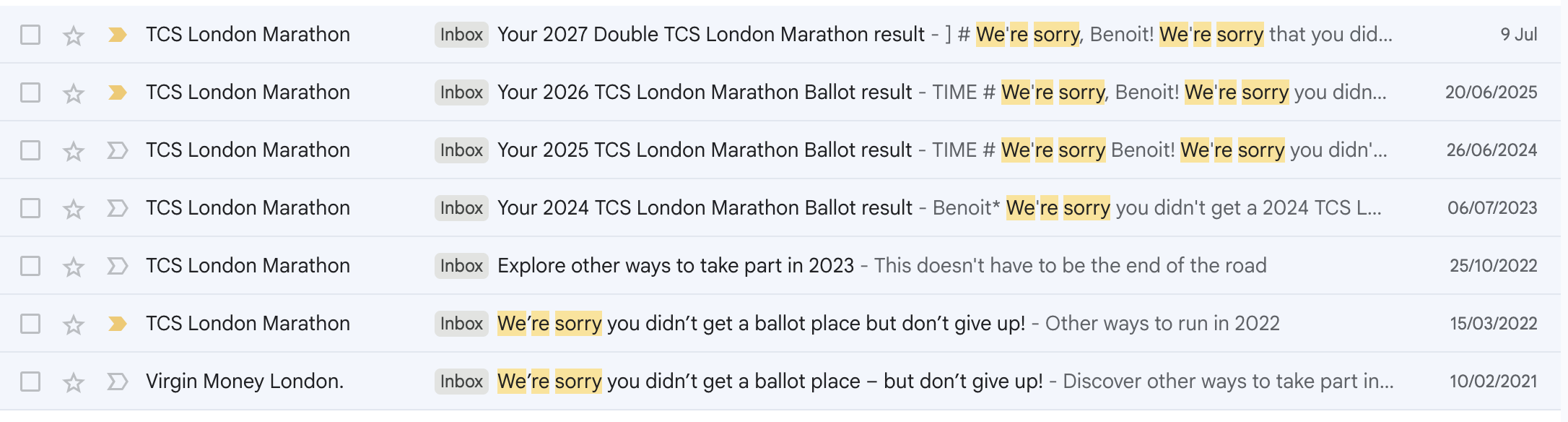
In 2026, London expanded to a two-day event: Saturday and Sunday races running simultaneously, roughly doubling the available spots. The rejection still arrived.
What the screenshots make visible is something the lottery odds obscure in the abstract: rejection is the default state. You don’t enter once and get unlucky. You enter every year and occasionally get lucky.
I’ve entered both NYC and London every available year since 2018. The rejections arrive with the same brief phrasing each time — “unfortunately you were not selected” — and you note it, re-enter for next year, and carry on.
The practical effect is that your marathon calendar gets built around other races while you wait. You don’t plan around New York and London; you plan around everything else and keep those slots open in case you eventually get drawn. Seven years of that builds a certain tolerance for bureaucratic disappointment.
What to Do With the Waiting Years #
The years between lottery attempts aren’t dead time. They’re actually where a lot of the more interesting running happens.
While waiting on New York and London draws, I’ve ended up at races I’d never have looked at otherwise. Hobart Marathon in 2025 had 450 finishers. Four hundred and fifty. After years of racing in cities of millions, running a marathon where you can count the field and know the volunteers by name is a genuinely different experience. The course is quiet, the logistics are simple, and you’re racing because you want to race — not because you managed to secure a spot in a competitive system.
Smaller local races are worth building into the Six Star calendar deliberately, not just as filler. They’re lower-cost, lower-stress, and often better for performance: fewer moving parts mean you race the race, not the logistics. They also keep the habit of racing alive through the long lottery waiting periods.
The pattern that works: treat each Major as a destination event with full preparation and budget behind it, and fill the calendar around it with one or two races that are simply accessible. The contrast ends up being part of what makes the Majors feel significant.
Sydney Changed the Calculation #
In 2023, Abbott added the Sydney Marathon to the Majors portfolio — the first new addition since the Six Star was established. I ran it in August 2025; the full race report is in my TCS Sydney Marathon 2025 write-up.

Sydney is a well-organised race and, for runners based in Asia-Pacific, it removes one major long-haul trip from the journey. But what it mainly did was split the goal in two.
Before Sydney, “complete the Majors” and “earn the Six Star” meant the same thing. They don’t anymore. Abbott has since signalled that Shanghai and Cape Town are likely to join the portfolio. If they do, the finish line moves again: eight races.
That creates two distinct goals: completing the original six, which is a fixed target, and completing all Abbott World Marathon Majors, which is open-ended. They’re different pursuits with different timelines, different costs, and different logistical profiles depending on where future races land.
My working answer is to treat the original six as the primary target. The two goals have different finish lines, different costs, and different timelines — only one of them is fixed.
Can I Finish the Original Six by 2028? #
The honest answer is: probably, but not entirely within my control.
I still need New York, London, and Boston. Two years is enough time to run all three if I secure entries. It’s not enough time to wait through two more lottery cycles each for New York and London, and it’s not enough time to close a 33-minute gap to BQ for Boston.
The realistic paths:
New York: Keep entering the lottery. If rejected again for 2027, a charity place is the next option — the fundraising minimum is manageable and the alternative is another year’s wait.
London: Same calculation. The 2026 race drew 1.1 million applicants. The odds don’t improve year-on-year. A charity place is increasingly likely if the 2027 lottery produces another rejection.
Boston: This one is different. No lottery, no charity route — you have to qualify. My current PB puts me roughly 33 minutes off a BQ for the 18–34 age group. Getting to sub-3:00 is a multi-year training project, not a logistical decision. Moving into the 35-39 age group (BQ: 3:05) gives slightly more room, but the gap remains significant. Boston may be the last one I complete, and the timeline will depend more on my training progression than on lottery luck.
The 2028 deadline is achievable for New York and London with charity places as the fallback. Boston is the variable. It depends on how much I can improve, and over what timeline.
What the Journey Looks Like from the Middle #
Seven years in, the thing I understand that I didn’t in 2018 is that this pursuit has two completely different clocks running at the same time. One clock runs on lottery luck — you wait, you enter, you wait again. The other runs on your legs. The frustrating part is that you can’t control the first one. The clarifying part is that you can fully control the second. After six years of New York and London rejections, I’ve stopped thinking about those races as delayed achievements. They’re scheduled. Boston is the one that depends entirely on me.
Looking at my remaining three, two are entry problems and one is a training problem. That distinction matters more than I understood at the start.
I’ll be entering New York and London again this year. And I’ll be running base miles toward a time that makes Boston a realistic target.
If you’re somewhere in your own Six Star journey, I’d be curious where the walls are for you — lottery luck, qualification, cost, or something else entirely.
Key takeaways:
- The entry system — not fitness — is the primary constraint for completing the Six Star
- London and New York lottery acceptance rates sit at 4–5%; rejection is the statistically expected outcome each year
- Charity places (£3,000–£5,000 minimum fundraising) are expensive but guarantee entry — sometimes the right tradeoff against another year of waiting
- Boston is the exception: no lottery, time qualifier required — it’s a training target, not a logistical one
Related posts: Tokyo Marathon 2024 | TCS Sydney Marathon 2025
- Photo by Henry Ren